Understanding Hydraulic Hose Markings
Release time:
2025-08-15
Understanding Hydraulic Hose Markings
Hydraulic hoses are critical components in fluid power systems, and understanding their markings is essential for safe and reliable operation. Selecting the wrong hose can lead to leaks, equipment failure, or safety hazards. Most hoses feature printed markings along their length, conveying key information such as the manufacturer, hose type, size, pressure rating, temperature range, and applicable standards.
Decoding Hose Information
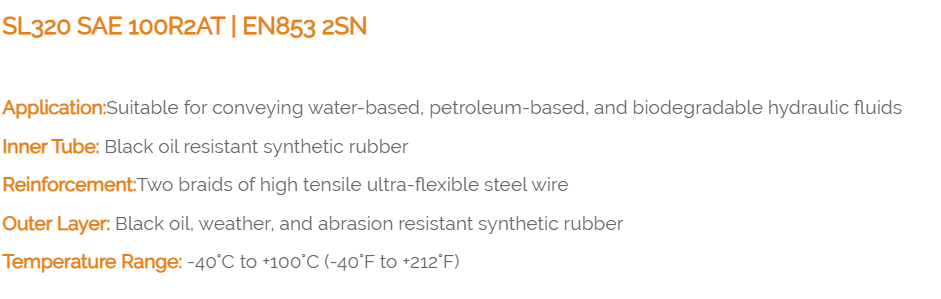
For example, a marking like “SAE 100R2AT - 1/2" - 350 bar - -40°C to +100°C” provides multiple layers of information. “SAE 100R2AT” indicates a high-pressure hose featuring a two-wire braid construction that meets SAE standards. “1/2"” specifies the internal diameter, affecting flow rate and fitting compatibility. “350 bar” denotes the maximum working pressure, and “-40°C to +100°C” defines the safe operating temperature range. Understanding these parameters ensures the hose can handle the system’s pressure and environmental conditions.
Professional Support for Hose Selection
Senflow offers a dedicated technical support team to assist with hose selection for complex hydraulic systems. By analyzing system pressure, temperature, fluid type, and dynamic conditions, Senflow experts recommend hoses that optimize performance, extend service life, and reduce operational risks. This professional guidance ensures users choose hoses that are fully compatible with their specific applications.
Practical Considérations
Special attention should be paid to hoses used with aggressive fluids, extreme temperatures, or highly dynamic systems, as proper selection directly impacts system reliability. Regularly checking that markings remain legible ensures traceability and supports preventative maintenance. In summary, hydraulic hose markings are essential technical indicators that enable informed decisions and maintain hydraulic systems safely and efficiently.
Related News
Strategic Sourcing of SL261 SAE R15 Wire Spiral Hydraulic Hoses for Extreme Applications
Evaluate the engineering behind the SL261 SAE R15 wire spiral hydraulic hose. Designed for 6000 PSI constant pressure applications, this technical guide breaks down high impulse life capabilities, multi-spiral steel reinforcement, and material resilience. Discover how standardizing high-pressure fluid components mitigates equipment downtime and ensures safety compliance for heavy machinery.
Внеплановые простои тяжелой техники требуют немедленных решений. FINO-100HP — это профессиональный ручной пресс для РВД, разработанный для высокоточной опрессовки без электричества в удаленных условиях. Обжим 2-оплеточных рукавов до 1" (25.4 мм), гарантия герметичности и строгое соответствие SAE/EN. Оснастите Ваш автопарк этим инструментом для минимизации эксплуатационных рисков.
Field Hose Repair Operations: Securing Reliability with the FINO-100HP Manual Hose Crimper
Unplanned heavy machinery downtime requires immediate, compliant solutions. The FINO-100HP is a professional manual hydraulic hose crimper designed for high-precision, electricity-free assembly in remote environments. Capable of crimping up to 1" 2-wire braided hoses, it ensures SAE/EN compliant, leak-free field hose repairs. Equip your fleet with this essential mobile tool to mitigate operational risks and maintain rigorous safety standards.
Equipment downtime in heavy machinery is a costly liability. Discover how the FINO 200Y digital 2-inch hose crimping machine ensures strict ISO/SAE compliance, eliminates micro-leaks, and maximizes hydraulic hose impulse life through precision engineering and a 6400 kN crimping force. Read the full technical guide to optimize your assembly process.
Specifying the SL770 Food-Grade Suction and Delivery Hose: Mitigating Risk in Sanitary Transfer
Equipment failure and batch contamination are unacceptable risks in commercial food processing. The SL770 food-grade suction and delivery hose is engineered to mitigate these threats, offering robust thermal resilience, high-pressure capacity, and absolute FDA compliance. Discover how upgrading your sanitary transfer lines can minimize system downtime and protect your operational bottom line.
Specifying the SL410 SAE 100R4 Hydraulic Hose: Mitigating Risk in Heavy-Duty Suction Lines
Ensure maximum reliability in heavy machinery with the SL410 SAE 100R4 hydraulic hose. Designed strictly for low-pressure suction and return lines, this fiber-reinforced rubber hose prevents pump cavitation and maintains structural integrity from -40°C to +100°C. Discover how standardizing on compliant fluid transfer components protects your equipment and optimizes your global supply chain.

Senflow Tech Co., Ltd. specializes in high-performance hydraulic and industrial hose systems, delivering globally certified solutions for industries such as construction, energy, mining, and shipbuilding — enabling smarter, safer, and more efficient fluid transfer.
No.903, Sixin Building, Hexi District, Tianjin, China 300220
Copyright © 2025 SENFLOW TECH CO.,LTD Powered by www.300.cn | SEO | Business License | Privacy Policy